
Tools and Training
Objectives and Goals: Writing Meaningful Goals and SMART Objectives
The content on this page follows the half-hour on-demand webinar:
Writing meaningful goals and SMART objectives
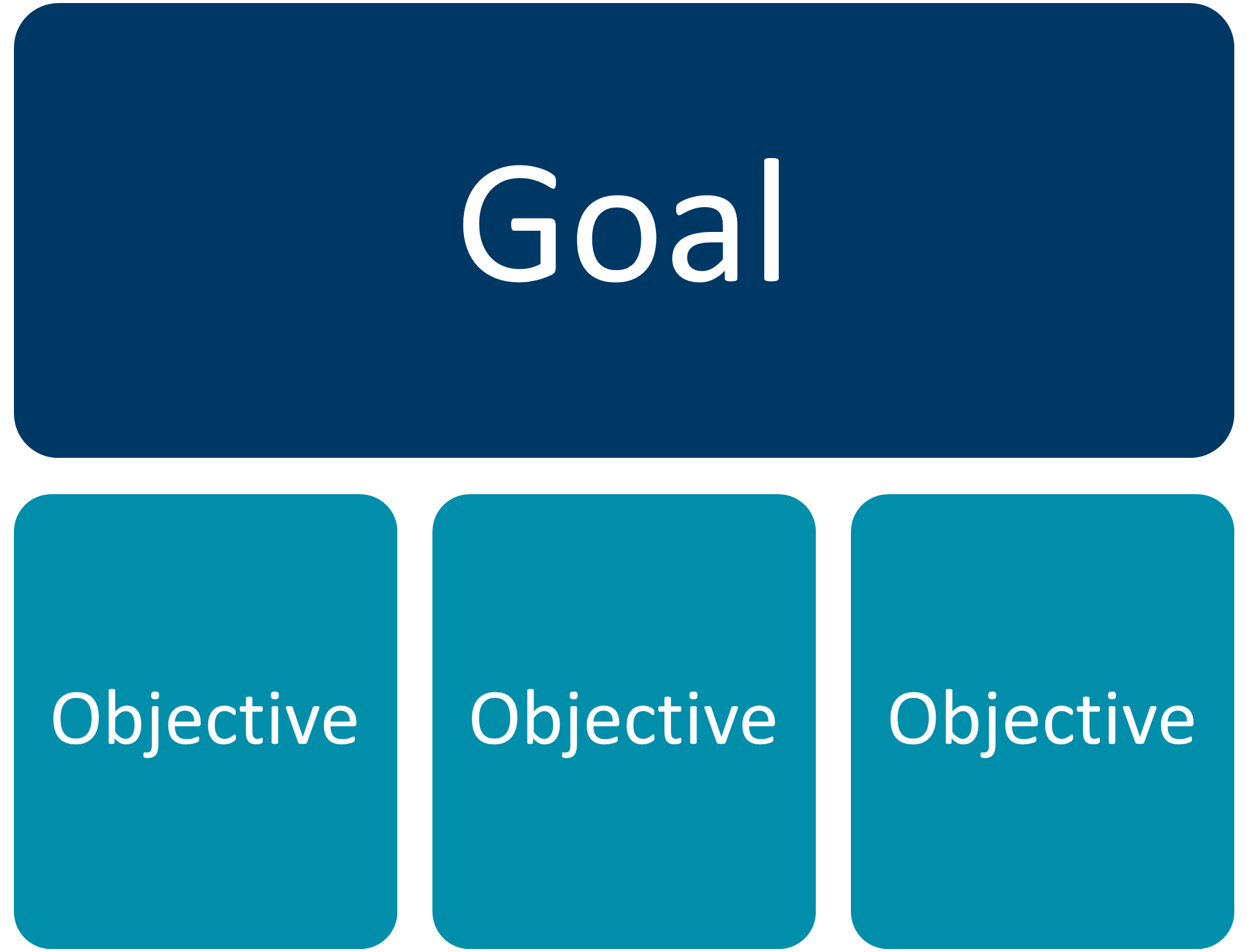 Meaningful goals and SMART objectives invite our colleagues and community members to more fully work together to promote community health and equity. They provide structure and direction to our work, show progress and room for improvement, and communicate impact.
- A goal is an aspirational statement about what you want to achieve
- An objective describes how you'll show progress toward your goal
Meaningful goals
SMART objectives
Further resources
Meaningful goals
What is a goal?
A goal is an aspirational statement about what you want to achieve:
- Broad, future-oriented statement that describes expected effect
- Defines scope
- Provides framework for objectives
Example: All employees in Tubman County work in environments that support mental well-being.
Checklist: What makes a meaningful goal?
- Concise
- Free from jargon
- Specific about expected effect
- Easily understood
- Declarative statement
- Does not include solution or specific service/program
- Conveys ultimate destination
Considering equity in writing goals
Many factors drive an organization's goals, like codes and statutes, funders, accreditation, and other plans. However: When setting goals, starting with an organization's needs might not be the right place to start, even though it's often the easiest or most intuitive.
We can't completely disregard forces like funders and and statutes, of course, but they also can't be the only thing that we consider when writing goals. Our commitment to health equity requires us to ask some questions when we're writing goals, especially as part of a community health improvement plan:
- Whose goals and standards are these?
- What do our goals and standards say about who and what we value?
- Who is at the table? Who is missing?
- Do the questions we're asking matter to those most impacted?
- Are we aiming upstream?
- What systems change is possible?
- How are we considering racism?
Source: Michigan Public Health Institute
SMART objectives
A SMART objective is one that is specific, measurable, achievable, relevant, and time-bound. SMART objectives provide the details for how a group or organization will achieve a goal.
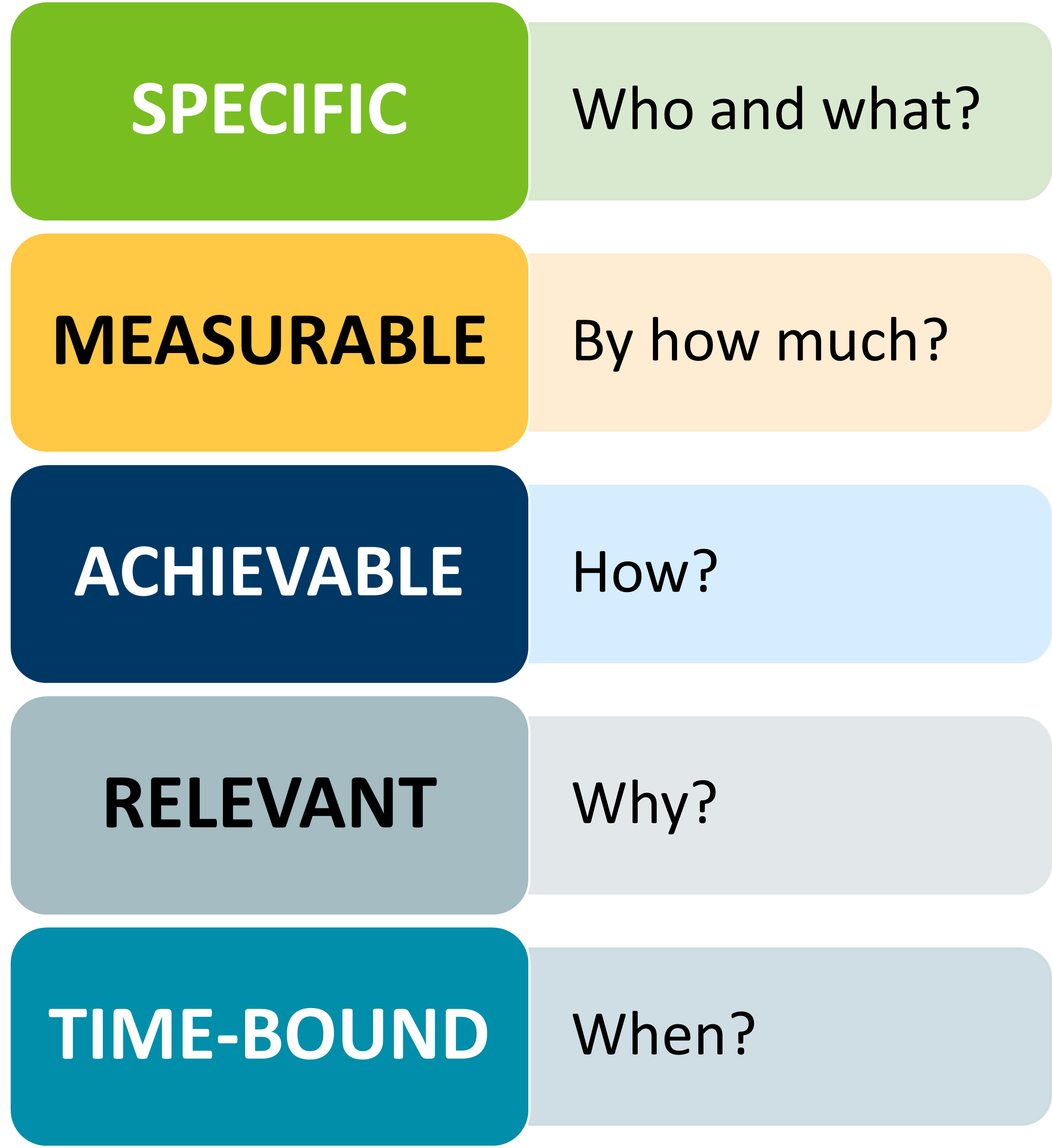
In order to understand how the parts of SMART objectives flow together, the order of the SMART components listed below will go out of order—SMTRA. This is because the Specific, Measurable and Time-Bound parts are clearly visible in the standard written format for objectives. The Achievable and Relevant pieces are more abstract and require reflection. Each of these parts will include an example objective that will be re-written to be SMART.
SMART objectives should:
- Include all components of SMART
- Relate to a single result
- Be clearly written (use plain language, avoid jargon)
Specific
Specific objectives:
- Are precise
- Are clear to team, partners, and other groups
- Use plain language and avoid jargon
- Use verbs that document action
Prompts to consider when writing specific objectives include:
- Who: Who will be impacted? Who is your focus population?
- What: What do you intend to impact?
Note that not all of these questions will apply to every objective.
Example: Reduce the percent of Tubman County students in grades 6 through 12 who have smoked cigarettes in the past 30 days.
Measurable
How will we show impact over time? Use a measure, to show progress toward a target:
- Measure: A measure is a number, percent, or standard unit used as a reference point from which change can be monitored.
- Target: A target is the direction we want to move the measure, or the level we want to reach.
- Data source: Be sure to tie your measure and target to a specific data source, like a regular survey or publication, or a state or local agency.
Prompts to consider when writing measurable objectives include:
- How much and in what direction will change occur?
- What data will you use to measure?
- Where will this data come from?
- Is there a stand-in or proxy measure to use if you cannot directly measure this objective? If not, would another measure be more appropriate instead?
Example: Decrease by 5 percentage points the number of Tubman County students in grades 6 through 12 who have smoked cigarettes in the past 30 days (baseline: 18%; data source: 2019 Minnesota Student Survey).
Time-bound
Time-bound objectives attach a reasonable date by which and objective will happen.
- Not too soon: Give enough time to demonstrate success and/or the connection between action and outcome
- Not too far away: Don't encourage procrastination, or remove the ability to connect the dots between action and outcome
- Consider when data will be available: May determine your time for you
Prompts to consider when writing time-bound objectives include:
- Is this time frame realistic?
- Should it be closer? Should it be further away?
- When will the data be available?
Example: By December 31, 2022, decrease by 5 percentage points the number of Tubman County students in grades 6 through 12 who have smoked cigarettes in the past 30 days (baseline: 18%; data source: 2019 Minnesota Student Survey).
Achievable
Objectives should be within reach for your partners, community, or team, and consider available resources, knowledge, and time. Remember, considering what's achievable for your team or organization often requires thought and discussion.
Prompts to consider when writing achievable objectives include:
- How will the group accomplish this objective?
- Does the current time frame or environment help or hinder this objective? Should we scale the target or time frame up or down?
- What resources will help us achieve this objective? What limitations or constraints stand in our way?
A note of caution about setting objectives for long-term, population-level change:
- Complex, long-term issues require decades of work for change; your organization's actions are one small part
- Who's on the hook if you don't achieve your target?
- Is it more appropriate to measure movement direction without setting a concrete target number? (e.g., increase, decrease, or maintain)
- Consider intermediate objectives when appropriate
Example intermediate objective with target direction AND number: By December 31, 2022, increase the percent of establishments that pass tobacco compliance checks from 75% to 80% (data source: 2020 Tubman County Sheriff's Department).
Example long-term objective with JUST target direction: By December 31, 2025, decrease the percent of Tubman County students in grades 6-12 who smoked cigarettes in the past 30 days (baseline: 82%, data source: 2019 Minnesota Student Survey).
Relevant
Relevant objectives align with a corresponding goal and with an organization or group's mission, vision, and values. They're important to partners, community members, and decision-makers, and they help achieve meaningful change for focus populations.
Prompts to consider when writing relevant objectives include:
- Will objective contribute to achieving goal?
- Is it worthwhile and meaningful to measure this objective?
Different ways to write SMART objectives
There are multiple approaches and ways to explain how to write SMART objectives. Here are some other sentence structures for objectives:
[Who] will do [what] resulting in [measure] by [when].
By [when], [who] will do [what] resulting in [measure].
By [when], [measure - includes who and what].
[Measure – includes who and what] by [when].
Further resources
Writing meaningful goals and SMART objectives
Minnesota Dept. of Health
Writing SMART Objectives (PDF)
Centers for Disease Control and Prevention
CHIP Collaborative Handbook: Community Health Improvement Planning (PDF)
Kansas Health Institute
"SMART" Objectives (PDF)
March of Dimes, Hawaii Chapter
Developing Goals, Objectives, and Performance Indicators for Community Health Improvement Plans (PDF)
National Association of County & City Health Officials (NACCHO)