
Secondary menu

  • About Us
  • News & Stories
  • Translated Materials
Minnesota Department of Health logo
  • Data, Statistics, and Legislation

    Data, Statistics, and Legislation

    Statistical reports, health economics, policy, and legislation.
    Data, Statistics, and Legislation
    • Community Health
    • Diseases and Conditions
    • Environmental Health
    • Health Behaviors and Risk Factors
    • Health Care Cost and Quality
    • Reporting and Exchanging Data
    • Legislation and Policy
  • Diseases and Conditions

    Diseases and Conditions

    A-Z disease listing, diseases and conditions by type.
    Diseases and Conditions
  • Health Care Facilities, Providers, and Insurance

    Health Care Facilities and Providers

    Directories of facilities, professional certifications, health insurance and patient safety.
    Health Care Facilities and Providers
    • Facility Certification, Regulation and Licensing
    • Insurance
    • Health Information Technology
    • Provider Certifications, Licenses, Registrations and Rosters
    • Patient Health and Safety
    • Health Care Homes
    • Notices Related to Health Records
    • Rural Health and Primary Care
    • Trauma System
  • Healthy Communities, Environments, and Workplaces

    Healthy Communities, Environments, and Workplaces

    Indoor air and drinking water quality, community prevention and emergency preparedness.
    Healthy Communities, Environments, and Workplaces
    • Community Wellness and Health Equity
    • Healthy Schools and Child Care
    • Healthy Businesses and Workplaces
    • Local Public Health
    • Environments and Your Health
    • Safety and Prevention
    • Emergency Preparedness and Response
    • Equitable Health Care Task Force
    • Transforming the Public Health System in Minnesota
  • Individual and Family Health

    Individual and Family Health

    Birth records, immunizations, nutrition and physical activity.
    Individual and Family Health
    • Vital Records and Certificates
    • Disabilities and Special Health Needs
    • Disease Prevention and Symptom Management
    • Healthy Aging
    • Healthy Children, Youth and Adolescents
    • Mental Health and Well-being
    • Reproductive Rights and Protections in Minnesota
    • Women and Infants
MDH Logo

Breadcrumb

  1. Home
  2. Healthy Communities, Environment and Workplaces
  3. Center For Public Health Practice
  4. Tools and Training From The Center For Public Health Practice
  5. Tools and Training - Public Health and QI Toolbox
Topic Menu

Center for Public Health Practice

  • Home: Center for Public Health Practice
  • Assistance & Workforce Development
  • Assessment & Planning
  • Connect
  • Funding Opportunities
  • Healthy Minnesota Partnership
  • Local Public Health Act
  • SCHSAC
  • Tools & Training
  • Contact Us

Related Sites

  • Minnesota Partners in Public Health Conference
  • Transforming Minnesota's Public Health System

Center for Public Health Practice

  • Home: Center for Public Health Practice
  • Assistance & Workforce Development
  • Assessment & Planning
  • Connect
  • Funding Opportunities
  • Healthy Minnesota Partnership
  • Local Public Health Act
  • SCHSAC
  • Tools & Training
  • Contact Us

Related Sites

  • Minnesota Partners in Public Health Conference
  • Transforming Minnesota's Public Health System
Contact Info
Center for Public Health Practice
651-201-3880
health.ophp@state.mn.us

Contact Info

Center for Public Health Practice
651-201-3880
health.ophp@state.mn.us

Tools and Training 
Fishbone Diagram

Also called cause and effect diagram

On this page:
What is a fishbone diagram?
How to construct a fishbone diagram
Examples of fishbone diagrams
More information
Source

What is a fishbone diagram?

A fishbone diagram helps team members visually diagram a problem or condition's root causes, allowing them to truly diagnose the problem rather than focusing on symptoms. It allows team members to separate a problem's content from its history, and allows for team consensus around the problem and its causes.

How to construct a fishbone diagram

1. Problem Statement

Draft a clear problem statement, on which all team members agree. Be specific about how and when the problem occurs.

Write the problem statement on the right side of your paper, at the head of the "fish." Your team will work out and away from this problem. Draw a line with an arrow toward the head of the fish—this is the fish's "backbone."

Fishbone

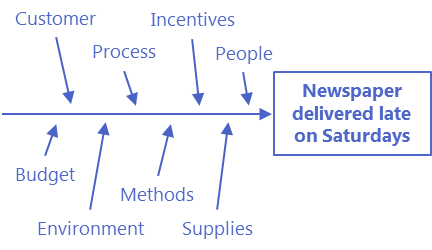
2. Categorization

Brainstorm major categories of your process or procedure. Connect them to the backbone, in "ribs." There is no specific number of steps or categories you might need to describe the problem; some common categories are listed below.
Img

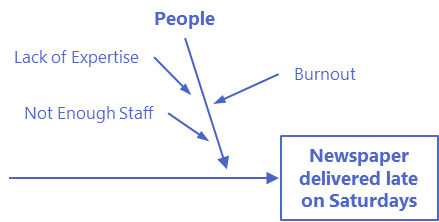
3. Contributing factors

Brainstorm possible problem causes, and attach each to the appropriate rib. Your team might find it helpful to place ideas on category ribs as they are generated, or to brainstorm an entire list of ideas and then place them on ribs all at once.

Ideally, each contributing factor would fit neatly into a single category, but some causes may seem to fit into multiple categories. If you have a contributing factor that fits into more than one category, place it in each location, and see whether, in the end, considering that factor from multiple points of view has made a difference.
Img

4. Ask: Why?

As you list a factor, repeatedly ask your team why that factor is present:

  • Why does staff lack expertise? (Because we don't attend training.)
  • Why don't we attend training? (Because we don't have the funding.)
  • Why don't we have the funding? (Because we haven't applied for grants.)
  • Why don't we apply for grants? (Because we're unaware of sources.)
  • Etc.

Sometimes this asking process is called the "Five Whys," as five is often a manageable number to reach a suitable root cause. Your team may need more or less than five whys. (More Information: Wikipedia: Five Whys.)

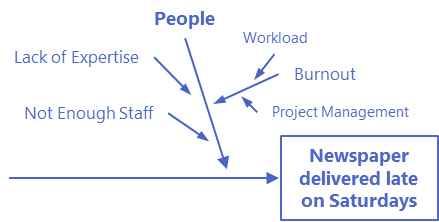
5. Many ribs: Deeper causes

You may end up with multiple branches off of each successively smaller rib. Your team might lack expertise, for example, because of a lack of training, but also because you didn't hire the right people for the job. Treat each contributing factor as its own "mini-rib," and keep asking why each factor is occurring.
Img

Continue to push deeper for a clear understanding. While you could likely brainstorm all day, however, it is important to know when to stop to avoid frustration. A good rule of thumb: When a cause is controlled by more than one level of management, remove it from the group.

6. Test for root causes

Test for root causes by looking for causes that appear repeatedly within categories or across major categories.

Hint: Use check sheets to determine the frequencies of various causes, and scatter plots to test the strength of cause-effect correlation.

Examples of fishbone diagrams

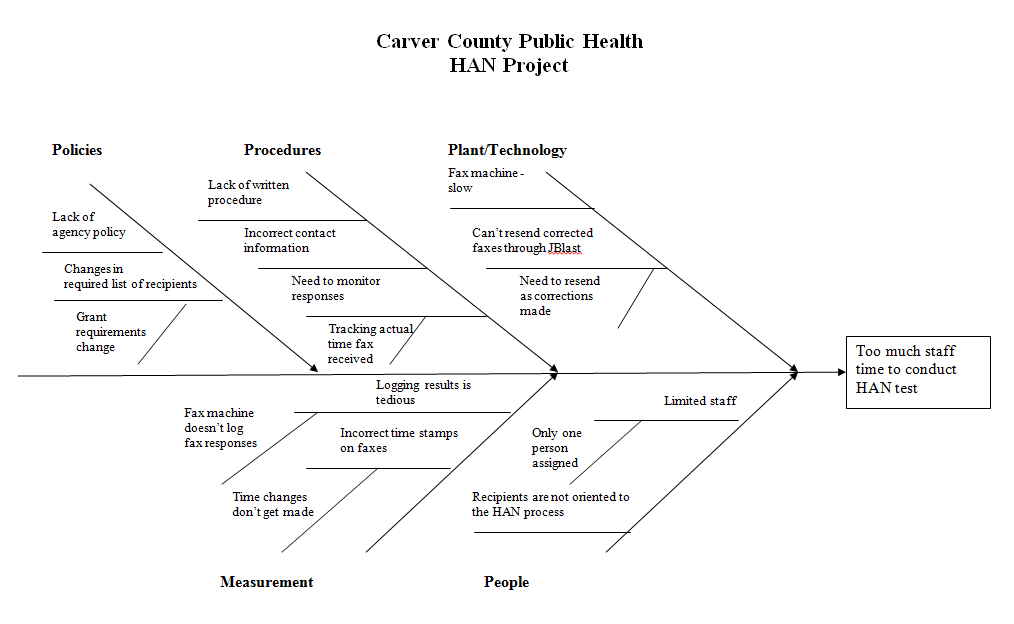
Health Alert Network; Carver County Public Health, September 2007
Click to view larger.
Carver County Fishbone

Introduction to Fishbone Diagrams (PPT)
AIDS Training and Education Centers

More information

Root Cause Analysis Toolkit
MDH Division of Health Policy

Fishbone Diagram
American Society for Quality

Fishbone Diagrams [Note: Video will autoplay]
Western Regional Public Health Training Center

Source

Public Health Memory Jogger
Public Health Foundation, GOAL/QPC

Tags
  • public health practice
Last Updated: 07/24/2025
  • Facebook
  • X
  • Instagram
  • LinkedIn
  • Youtube

About MDH

  • About Us
  • Grants and Loans
  • Advisory Committees

Legal & Accessibility

  • Privacy Policy
  • Equal Opportunity
  • Feedback Form

Careers at MDH

This is an official website of the State of Minnesota. Visit Minnesota.gov for more information.