
Table of Contents Next Chapter
CHS Administration Handbook
Introduction: Public Health in Minnesota
On this page:
What is public health?
What does public health do?
Minnesota's public health system functions as a partnership between state and local governments, and is designed to ensure that the public's health and safety are protected statewide while providing local governments with the flexibility needed to identify and address local needs.
In a time of constrained resources, community health boards need to continue to build capacity to address increasingly complex public health issues. Many regions use similar approaches to maximize resources, including cross-jurisdictional sharing to achieve economies of scale, increasing efficiency, focusing on quality improvement, developing the public health workforce and leadership, and emphasizing the importance of a strong public health infrastructure.
What is public health?
Public health focuses on the health needs of the population as a whole, and gives priority to preventing problems over the early detection and treatment of problems. By focusing on the greatest good for the greatest number of people, public health organizes community resources to meet health needs and takes positive action to address community health issues.
Public health is based on an understanding of the causes of health problems; a person's health outcomes can be impacted by everything from genetics, to environmental factors, to living conditions, to cultural norms, and to individual choices. It is generally accepted that overall population health is determined by the four factors below, approximately weighted according to their impact.
One theory that breaks down the factors that influence health follows:
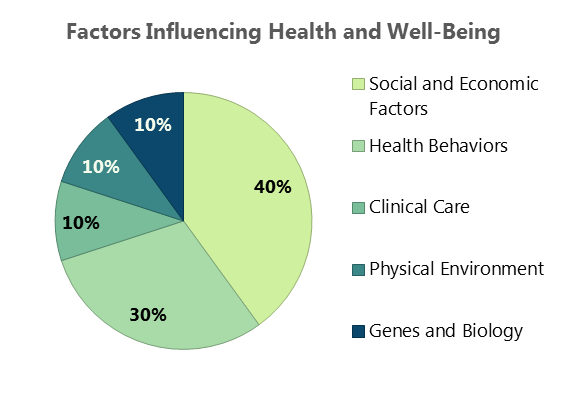
Public health is closely intertwined with many other issues that affect public health—called social determinants of health. For example, poor health habits like smoking or excess alcohol use can lead to chronic diseases and increased hospital costs. Youth violence can result in increased costs for court time and correctional facilities. It can be difficult to visualize the broad factors that influence health, which can make public health difficult to describe in concrete terms.
The Centers for Disease Control and Prevention (better known as the CDC) compiled the following Ten great health achievements -- United States, 2001-2010:
- Vaccine-Preventable Diseases
- Prevention and Control of Infectious Diseases
- Tobacco Control
- Maternal and Infant Health
- Motor Vehicle Safety
- Cardiovascular Disease Prevention
- Occupational Safety
- Cancer Prevention
- Childhood Lead Poisoning Prevention
- Public Health Preparedness and Response
This list is based on the opportunity for prevention, and the impact on death, illness, and disability in the United States.
What does public health do?
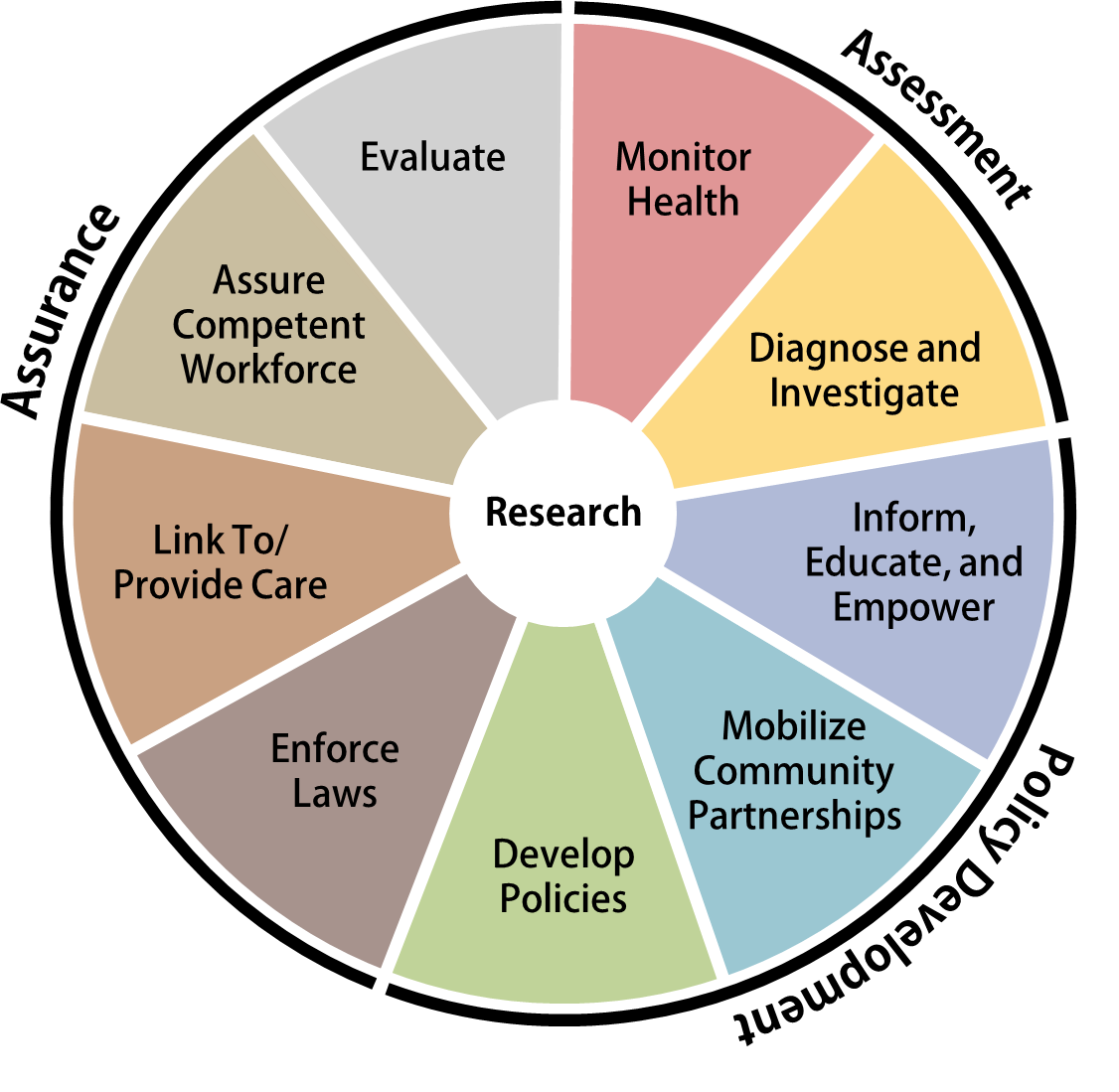
According to the Institute of Medicine's well-known 1988 study, The future of public health, the core functions described below are carried out primarily by government and constitute the most critical foundations of an effective public health system.
Assessment
The assessment function of public health can be viewed as "knowing what needs to be done." This encompasses activities such as epidemiological surveillance, data collection and analysis, monitoring and forecasting, root cause analysis, and other research practices. The assessment function is often used to facilitate decision making by collecting the best evidence with which to weigh competing options and consider the allocation of limited resources.
Policy development
The policy development function of public health can be viewed as "being part of the solution." This includes being involved in the crafting of legislation, rules, policies, practices, and budgets. In its policy development capacity, a public health entity may plan for and set priorities, provide leadership and advocacy, convene and negotiate with stakeholders, mobilize resources, provide training, or encourage private action. In policy development, the process is often just as important as the product—it will ideally be fair, inclusive, and far-sighted.
Assurance
Assurance can also be thought of as "making sure it happens." The government can ensure public health services are delivered by mandating them, providing services directly, or incenting other sectors to take action. This often requires implementation of legislative language, regulation, reporting on progress, and holding stakeholders accountable. Exercising this authority comes with great responsibility and entails a strong level of commitment to the welfare of the community. In its assurance capacity, the government is challenged to strike the appropriate balance between free market interests and social equity or the greater good.