Source Water Protection (SWP)
- SWP Home
- Protecting Drinking Water Sources
- SWP Requirements and Recommendations
- SWP Grants
- Groundwater Protection Initiative - Accelerated Implementation Grant
- SWP Awards
- Laws and Rules
- SWP Web Map Viewer
- Surface Water Program
- SWP Reports and Data
- SWP Implementation Resources
- Source Water Assessments
- Stories from the Source
Related Topics
- Water: Business and Government
- Drinking Water Information for Consumers
- Water Testing and Data Reports
- Minnesota Well Index
- Clean Water Fund
Environmental Health Division
Edina Seals Hundreds of Unused Wells to Protect Drinking Water
Stories from the Source
The city of Edina has been working on various wellhead protection efforts since their first Wellhead Protection Plan was approved in 2001. The city has put significant staff time and financial resources into implementing actions from the plan related to private well education and sealing. This work has contributed to 356 private unused wells being sealed in the city between 2016 and 2024!
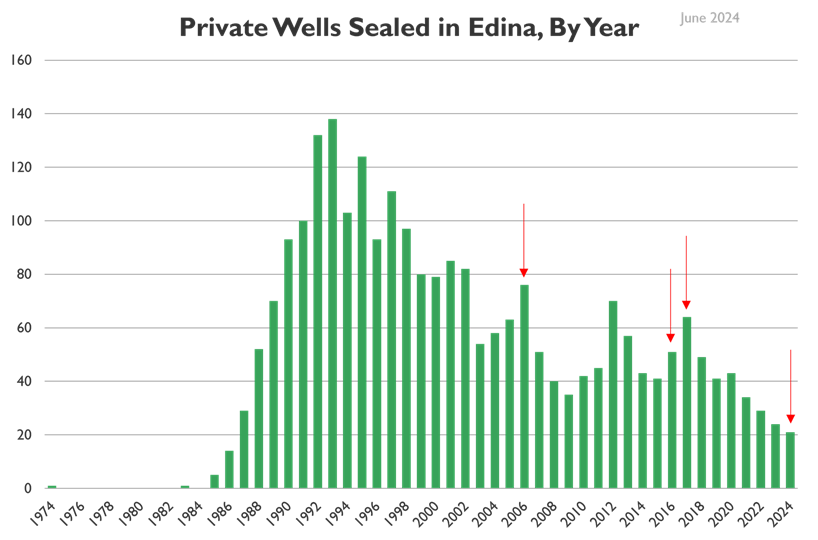
In 2014, the city of Edina successfully applied for a Source Water Protection (SWP) Implementation Grant, made possible by the Clean Water Fund, to establish a comprehensive, spatial database of potential sources of contamination within their drinking water supply management area (DWSMA). Their DWSMA includes nearly the entire city and extends outside of city limits. The DWSMA included many private wells , including actively used wells, sealed wells, and wells with unknown status, which are potential sources of contamination. Prior to this database, city records of wells were kept in a simple list maintained by the Edina Public Works and Health Divisions. Having the electronic database not only allowed for increased efficiency and effectiveness in the city’s work, but it also led to the creation of an online interactive map of wells and their statuses within the city.
In 2016, Edina obtained another SWP Implementation Grant, this time for a direct mailing to the property owners of 490 wells identified in the database as unsealed. The mailings included a letter from the city as well as educational information on sealing unused wells and information on Hennepin County’s well sealing grant. Shortly after the letters were mailed out, staff began receiving inquiries about the wells and how to get them properly sealed. Some property owners let the city know that their well had already been sealed and the city worked with MDH to obtain official sealing records for these wells for the city’s database.
The City of Edina successfully applied for yet another SWP Implementation Grant in 2018 and used the funds to help property owners in their community seal eight inactive private wells. This grant funding was critical in kickstarting the city’s private well sealing grant program that remains active to this day. Another benefit of the program has been the education and increased awareness around proper well management for groundwater protection. Applicants and interested individuals told city staff that they didn’t know their private wells needed to be sealed until they saw the promotional materials and educational messaging for the grants. Through the program, they have been able to verify the presence of some wells that were previously suspected, but were not verified, and thus may have gone unsealed for a long time.
After successfully launching their private well sealing grant program with SWP Implementation Grant funding, the City of Edina worked to establish a $5,000 revolving budget for well sealing to maintain the program. The grant program covers 25% of the cost to seal a well, up to $600. Many people pair this program with Hennepin County’s program, which covers 75% of the cost up to $2,000. The revolving budget was raised to $11,000 for 2024 to meet increased demand. Earlier this year, the city sent out another round of direct mailings, similar to those sent out in 2016. However, this time hundreds more residents received these letters because of the 2018 database improvements that revealed likely wells at many more homes. The City of Edina’s current database contains over 3,700 wells, 2,579 of which have a “sealed” status and 1,034 have an “unknown” status.
From 2020 to 2024, 34 wells have been sealed through the city of Edina’s grant program. This is in addition to the many instances over the years that city staff have identified unsealed wells that were found in home construction projects.
The city of Edina plans to continue their private well sealing grant program and maintain their Groundwater Wells interactive map indefinitely. City staff are aware that property owners have acted on sealing their inactive wells because there are grants that can help with the costs. The letters have reached many fixed-income residents that likely would not be able to afford sealing their wells without grant funding. The city of Edina hopes to use their experiences to work with MDH staff and neighboring cities to improve processes and data availability and protect community groundwater resources through sealing private wells.