
About Community Health Workers
Who are CHWs?
According to the American Public Health Association, a community health worker (CHW) is a frontline public health worker who is a trusted member of and/or has an unusually close understanding of the they community serve. This trusting relationship enables the CHW to serve as a liaison/link/intermediary between health and social services and the community. They facilitate access to services and improve the quality and cultural competency of service delivery.
A CHW also builds individual and community capacity by increasing health knowledge and self-sufficiency through a range of activities such as outreach, community education, informal counseling, social support and advocacy.
CHWs bridge gaps between health and social services and the community. CHWs:
- Increase access to preventive healthcare and social services
- Reduce avoidable healthcare expenses
- Help service providers provide quality and culturally appropriate care
- Address the community conditions that impact health
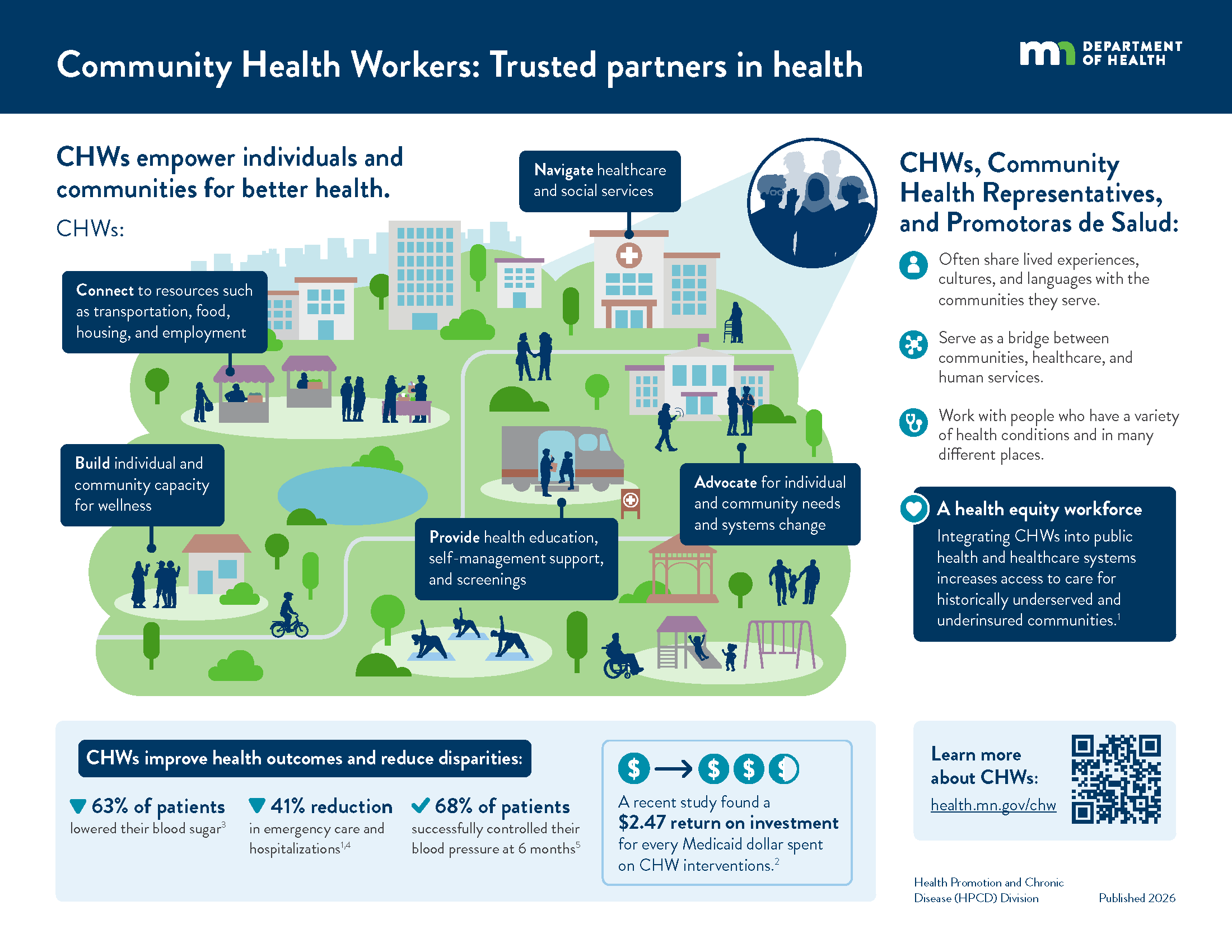
![]() | Community Health Workers: Trusted partners in health (PDF) Community health workers empower individuals and communities for better health. Learn more about CHWs and how they work in Minnesota. |
What do CHWs do?
CHWs can work under many different job titles, including promotores de salud/promatora, community health representative, community advisor, outreach worker, peer educator, patient navigator, and other related titles. CHWs work in a variety of settings including health care, public health, communities, schools, community-based organizations, and more.
- CHWs work with individuals to increase health knowledge, self-sufficiency, and access to care and resources.
- CHWs empower individuals and communities for better health through a range of activities such as system navigation, education, connection to resources, informal counseling, support, and advocacy.
- CHWs are effective in supporting health, reducing health disparities, and preventing chronic health conditions, injury, violence, and substance use disorders.
Based on population needs, training, and specific work setting, for example in a community or clinic environment, a CHW´s job duties may vary. Learn more about the CHW profession: Caring Careers: Community Health Worker (PDF).
For more information on the role of CHWs in different settings, visit Role of Community Health Workers.
CHW Scope of Practice
In 2010, the role of community health worker was officially recognized by the Bureau of Labor Statistics of the Department of Labor as 21–1094 Community Health Workers.
The Minnesota CHW Scope of Practice aligns with the CHW Roles, Skills and Competencies outlined by the National Council on the CHW Core Consensus Standards. The Minnesota Community Health Worker Alliance defines the CHW Scope of Practice as:
As members of the local community, community health workers are well positioned to facilitate communication between provider and patient to clarify cultural practices, educate community members about appropriate use of the healthcare and social service systems, and educate the health and social service systems about community needs and perspectives.
Community health worker roles include promoting access to primary care through culturally competent outreach and enrollment strategies, making referrals and coordinating services, educating patients on the knowledge and skills needed to obtain care, providing follow-up services to facilitate continuity of care, enhancing access to coverage by assisting clients in enrolling in public assistance and other programs for which they qualify, and linking clients to and informing them of available community resources.
Community health worker roles include engaging communities and individuals in advocating for themselves, articulating and advocating on behalf of the needs of the community and individuals (especially those unable to speak for themselves), and understanding the resources and support available in local communities.
Community health workers provide direct services to patients and providers, including providing culturally appropriate information on health, wellness, and disease prevention and management; assisting clients in self-management of chronic illnesses and medication adherence; organizing and/or facilitating support groups; providing referrals and linkages to preventive services (e.g., screenings); and conducting health-related screenings.
Community health workers work to identify individual and community needs. They help build the capacity of individuals for wellness. They help build the capacity of communities by addressing the social determinants of health. They also mentor other community health workers to build their capacity. They promote their own professional development through continuing education and peer support.
How are community health workers trained in Minnesota?
CHW Certificate Program
Minnesota was the first state to create and offer a statewide CHW curriculum based in post–secondary education. The Minnesota standardized curriculum is a competency–based, 16–credit certificate program that provides foundational core competencies and creates a pathway for students interested in a wide range of health and social services careers.
The CHW Certificate Program is voluntary; however, in Minnesota, in order for Medicaid-eligible CHW employers to receive Medical Assistance or Medicare reimbursement for authorized CHW services, the CHW must hold a CHW certificate from one of the schools that offer the standardized curriculum and enroll with Minnesota Department of Human Services.
The following schools currently offer the certificate program:
- Anoka Technical College (fully online)
- Minnesota West Community and Technical College (fully online)
- Normandale Community College (hybrid)
- Northwest Technical College (fully online)
- St. Catherine University (fully online)
The CHW Certificate Program curriculum includes competencies in CHW:
- Roles, Advocacy, Outreach and Resources
- Health Communication, Teaching and Capacity Building
- Documentation, Legal and Ethical Responsibilities in Community Health Work
- Health Promotion Competencies (health promotion and chronic disease prevention, maternal child health, healthy aging, management of chronic conditions, mental health, oral health)
- Practice Competencies - Internship
In order to enter the program, most schools require CHW a high school diploma, GED, or equivalency. For more information on the CHW program requirements, scholarships, and financing options, interested students can reach out to the schools directly or reference resources on Minnesota Community Health Worker Alliance: Education Opportunities.
Apprenticeship
Minnesota has a CHW Registered Apprenticeship Program through the Minnesota Department of Labor and Industry to provide standardized on the on-the-job training and mentorship during the first year of employment. The Minnesota Community Health Worker Alliance is an employer Sponsor for the Registered Apprenticeship Program. CHW Apprenticeship:
- Supports organizations to develop employer paid registered apprenticeships programs.
- Supports organizations and apprentices to develop tailored on the job training.
For more information on apprenticeship benefits and processes visit: Apprenticeship – Minnesota Community Health Worker Alliance.
Continuing education and training
There are many training opportunities offered in Minnesota and Nationally for CHWs, whether they have completed the CHW Certificate Program or not. Continuing education is not required in Minnesota.
MDH offers free online trainings for CHWs to advance knowledge on health promotion and chronic disease prevention topics. These online courses are intended to build upon the core competencies of the CHW Certificate Program in Minnesota.
- MDH Community Health Worker Training Courses
- The CHW Roles and competencies from the online courses can be found in this companion document: Community Health Worker Roles in Chronic Disease Prevention and Management Guide (PDF)
The Minnesota Community Health Worker Alliance offers continuing education and training for CHWs, including:
- CHW Learning Circle: Peer Support
- CHW Leadership Institute
- CHW Platform: Join Minnesota Community Health Worker Alliance
Licensure and certification
Similar to many states, Minnesota does not have formal credentialing, certification, or licensure process for CHWs. GIven this structure, there are no continuing education or training requirements beyond the CHW Certificate Program. Minnesota has not enacted occupational regulation of CHWs and does not define the CHW scope of practice in statute or rule. The Minnesota Department of Health uses the definition provided by APHA, described above.
Minnesota Statute 256B.0625, Subdivision 49, defines medical assistance covers care coordination and patient education services provided by a CHW if the CHW has received a certificate from the Minnesota State System’s approved CHW curriculum. The Minnesota Department of Human Services outlines the scope of CHW services that are billable through Minnesota Health Care Programs.
For more information visit: Community Health Worker Billing and Reimbursement
