
2026 Public Health Laboratory Newsroom
Meet the Scientist: Chemical Threat Preparedness Coordinator Breahna Giles
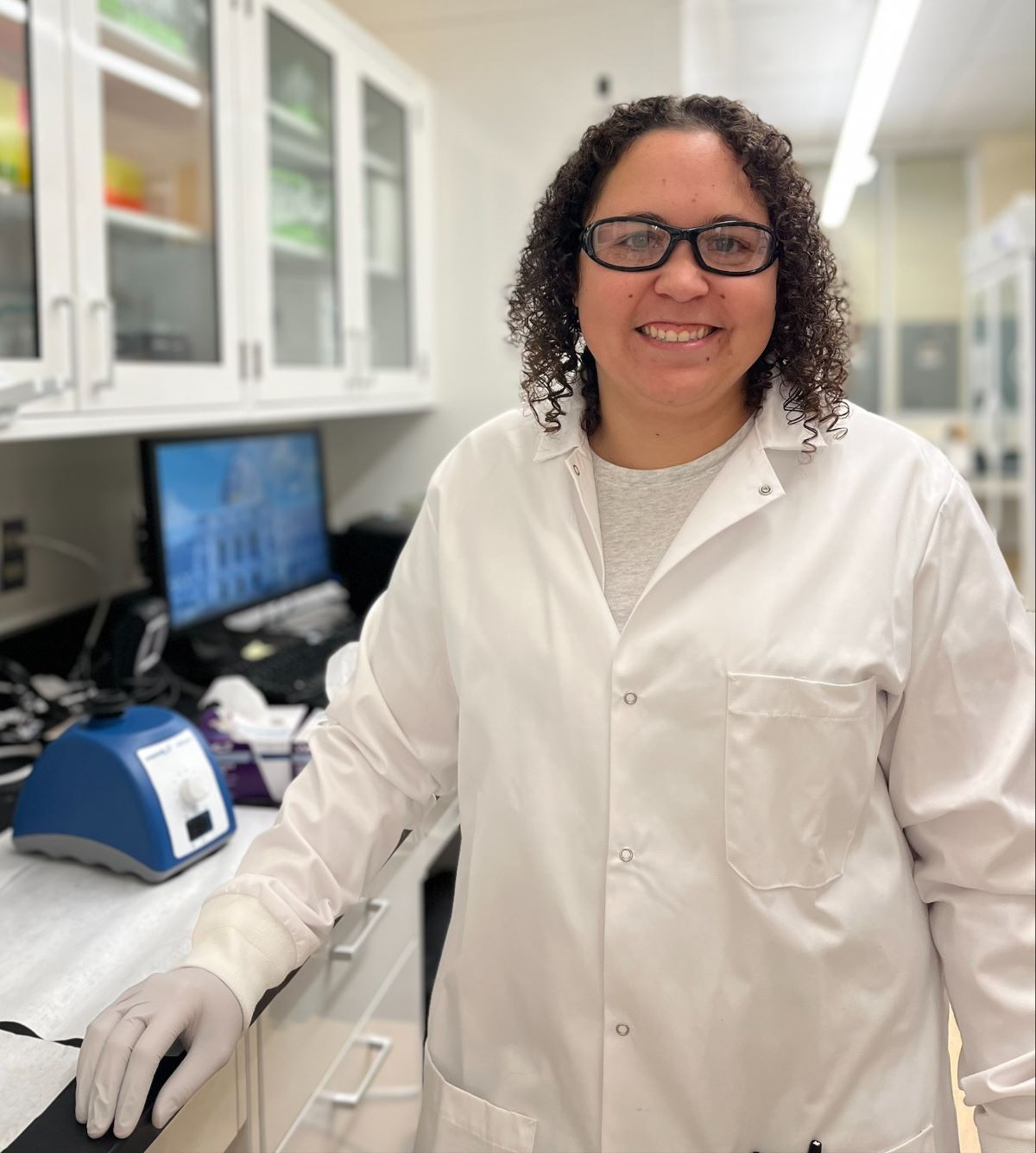 Breahna Giles owns the official job title of research scientist at the Minnesota Public Health Laboratory, but most of her time is spent as a chemical threat preparedness coordinator. In this role, she works with hazmat teams, the National Guard’s 55th Civil Support Team, and many other organizations to respond to emergencies involving suspected dangerous chemical substances like ricin or hydrogen cyanide. She also helps with police investigations, as in a recent case involving thallium poisoning.
Lifelong Fascination with Science and Puzzles
Starting at a very young age, Breahna Giles knew that math and science would provide her career path. She also loved puzzles like sudoku. The two interests combined when she learned about forensic science through the television show “CSI: Crime Scene Investigation.” Forensic scientists use scientific knowledge and principles to solve problems within criminal investigations.
Giles attained an undergraduate degree in biochemistry and a master’s degree in forensic science. In 2013, she began working in drug chemistry in the crime laboratory of the Southwestern Institute of Forensic Sciences in Dallas County, Texas. Giles moved to Minnesota in 2017 and did similar work for the Department of Public Safety and Bureau of Criminal Apprehension.
Joining the Minnesota Public Health Laboratory
In 2023, Giles started in her current position at the Minnesota Public Health Laboratory. She coordinates Minnesota’s chemical threat preparedness as part of The Laboratory Response Network for Chemical Threats (LRN-C). The LRN-C is a national network of local and state public health laboratories, the Centers for Disease Control and Prevention (CDC), and many other national and local institutions. The LRN-C stands ready to launch a rapid response to any threat involving a chemical warfare agent (PDF).
Such chemical warfare agents can be in the form of gases, liquids or powders. If a person were exposed to one, symptoms would likely manifest very rapidly. The person would experience symptoms like rashes, blisters, eye irritation, etc. within minutes or hours.
A health care provider or first responder would recognize the symptoms of a chemical warfare agent and report to the Minnesota Regional Poison Center or a Minnesota Duty Officer. The hospital or clinic would then get a sample from the person and send it to the Minnesota Environmental Laboratory, a section of the Minnesota Public Health Laboratory.
Breahna Giles would direct the testing of the sample for dangerous chemical agents. She would simultaneously coordinate with law enforcement and hazmat teams to discover the source of the exposure and gather and analyze environmental samples. The Minnesota Environmental Laboratory analyzes samples to detect hundreds of different substances.
Minnesota is home to one of only ten Level 1 laboratories within the Laboratory Response Network for Chemical Threats (LRN-C). Level 1 laboratories can test samples 24/7 in the event of a large-scale chemical emergency. They have sufficient capacity and highly trained staff to run a high volume of tests very quickly. If other laboratories need assistance, they turn to the Level 1 laboratories.
In a typical year, Breahna Giles and the Minnesota Environmental Laboratory will test around 10 or 12 samples for chemical agents. Much of Giles’ day-to-day work is spent training and collaborating with coworkers and other organizations in chemical threat preparedness. She runs tabletop and full-scale training exercises that simulate chemical threat emergencies. Eric Lundquist holds a similar role at the Minnesota Public Health Laboratory managing preparedness for emergencies involving biological agents.
Giles also tests samples for the Healthy Kids Minnesota program, which monitors children’s exposures to chemicals that may harm development. Another program she assists with is Minnesota Drug Overdose and Substance Use Surveillance Activity (MNDOSA), which tracks the illicit substances involved in overdoses that led to hospitalization.
When Giles joined the Minnesota Public Health Laboratory, she immediately joined its Diversity, Equity, Inclusion, and Belonging (DEIB) Collaborative. A queer multiracial woman, she found a welcoming and invigorating community within the collaborative and quickly became its co-chair. The collaborative has organized a regular book club, coffee and community get-togethers, a potluck, bake sale, a Women in STEM March Madness-style bracket, and much more for all members of the Minnesota Public Health Laboratory.
Giles is also a fervent sports fan and is descended from a line of star athletes. Her grandfather, Brian Giles, was a professional baseball player who suited up for the New York Mets, Milwaukee Brewers, Chicago White Sox and Seattle Mariners. Her great-great-grandfather, George Giles, was a star first baseman in the Negro Leagues from 1927 through 1938. In late July, Breahna and her family will attend a ceremony to induct George Giles into the Kansas Sports Hall of Fame.
Return to the 2026 Public Health Laboratory Newsroom.