
Drinking Water Protection
- Drinking Water Protection Home
- About Us
- A-Z Index of Contaminants in Water
- Community Public Water Supply
- Drinking Water Grants and Loans
- Drinking Water Institute
- Drinking Water in Schools and Child Cares
- Drinking Water Revolving Fund
- Laws and Rules
- Noncommunity Public Water Supply
- Source Water Protection
- Water Operator and Certification Training
- Drinking Water Protection Contacts
Related Topics
- Annual Reports
- Drinking Water Risk Communication Toolkit
- Drinking Water Protection External Resources
- Fact Sheets
- Forms
- Invisible Heroes Videos: Minnesota's Drinking Water Providers
- Noncom Notes Newsletter
- Sample Collection Procedures (videos, pictures, written instructions)
- Waterline Newsletter
Related Sites
- 10 States Standards
- Clean Water Fund
- Health Risk Assessment – Guidance Values and Standards for Water
- Minnesota Well Index
- Water and Health
- Wells and Borings
Environmental Health Division
Waterline: Fall - Winter 2025
Editors:
Rebecca Toews, Stew Thornley, Alycia Overbo
Staff:
Alvine Laure Ekame, Johanna Hayden, Kylie Jacobsen, Leslie Winter
Contributors: Jackie Becker, Hannah Mendez, Lucas Martin, Anna Schliep, David Weum
Get email updates to The Waterline newsletter by signing up below. An e-mail notice is sent out each quarter when a new edition is posted to the web site.
On this page:
- St. Paul Regional Water Services upgrades treatment plant
- MDH unveils new Drinking Water Action Plan
- Source Water Protection unit debuts new grants database
- MDH releases statewide nitrate report
- Safe drinking water fee approved in state legislature
- Meet Chris Elvrum, Drinking Water Protection section manager
- Farewell, Stew: Cheers to three+ decades being in-over-your-head in water
- Alycia Overbo receives leadership award
- Lead and Copper Rule: Health equity in action
- Minnesotans judge drinking water at the Great Minnesota Get-together
- Adrian’s collaborative efforts against nitrate
- Reminder to all water operators
- Calendar
St. Paul Regional Water Services upgrades treatment plant
by Lucas Martin, Metro Region District Engineer
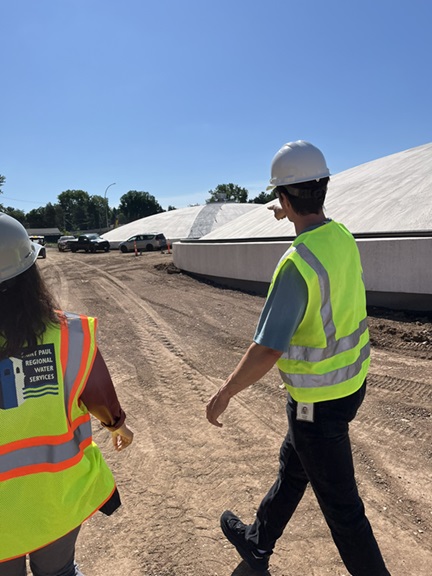
St. Paul Regional Water Services (SPRWS) showcased their new McCarrons treatment plant on Thursday, Sept. 25.
The project replaced aging infrastructure in all of the former site’s pre-treatment (everything before the filters) with new components. It also added in ozone treatment to help deal with contaminants of emerging concern.
Construction started on the plant in 2022, and the system invested $250 million—the largest project in its history—to replace much of the plant’s aging equipment, some from the 1920s and 1950s. This overhaul fixes long-standing problems and strengthens the system against future water quality threats.
Minnesota Department of Health (MDH) was instrumental in planning and shaping the project through plan review and advisement. Drinking Water Protection (DWP) compliance staff toured the facility before, during, and after completion.
The project includes four new clarifier units that will replace all the old flocculation and sedimentation infrastructure. Initially, they will run about 20% of their softened water through this first new clarifier unit and monitor performance. The project also includes a new lime softening building, which replaces the old lime building. The new lime slaker units will be a huge improvement over the old ones. They allow better control of lime mixing and require less maintenance.
Another feature of the project is the ozone generation units that will be used to begin ozone treatment, which is a new treatment process for SPRWS.
This modernization is more than an upgrade for the system, says SPRWS general manager Racquel Vaske.
“By blending time-tested methods with new technology, SPRWS is building a future where clean, reliable water remains a source of pride for St. Paul and the 14 communities we serve.”
SPRWS is running new systems alongside the old ones to maintain uninterrupted water service. They will test all systems and finish final work by mid-2026. The old equipment will be demolished, and the SPRWS plans to build a new lab and educational center to continue to meet the needs of the city and its customers.
MDH unveils new Drinking Water Action Plan
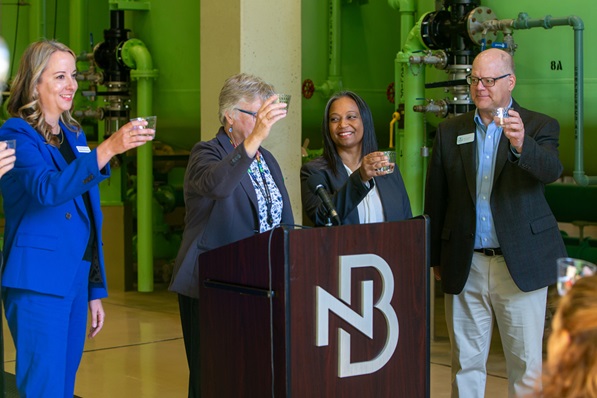
On Oct. 10, Minnesota Department of Health officially released the first official Minnesota Drinking Water Action Plan. The Plan is a 10-year framework of actions for ensuring everyone, everywhere in Minnesota has safe and sufficient drinking water. The Plan both uplifts many of the efforts underway and names some areas where there is need for more support and attention, including:
- Addressing the unfair challenges over 1.2 million private well users face and the challenges nearly 800 small city water systems face in testing for and addressing contaminants.
- Reducing the impacts from flooding and other climate change-related events on drinking water.
- Upgrading and modernizing data systems that house water quality data.
Read the full plan at Minnesota Drinking Water Action Plan (PDF).
MDH debuts new grants database
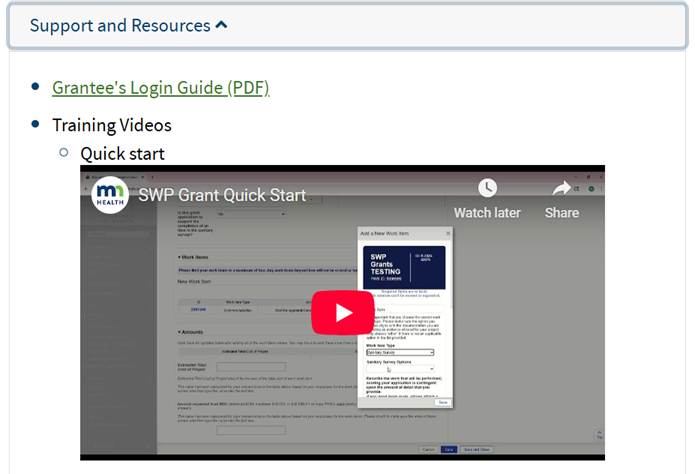
The Minnesota Department of Health (MDH) is launching a new online system for applying for source water protection (SWP) grants starting in fall, 2025. The new database, called Fluxx, helps streamline the grants application process.
Applicants can track progress of their grants online, collaborate with MDH staff or others on their application, save an application online and come back to it, complete reporting requirements, and more.
Source Water Protection Plans can be: 1) MDH-approved wellhead protection plans 2) MDH-approved wellhead protection action plans, or 3) MDH-endorsed surface water intake protection plans.
Dates of Upcoming Grant rounds:
Competitive: 11/18/2025 - 12/18/2025
For more information, please visit Source Water Protection Grants to access the new SWP grants database.
MDH releases statewide nitrate report
The state’s Drinking Water Protection program released its assessment of nitrate levels in Minnesota’s public drinking water in October. The report, which covers data gathered in 2023-2024, shows that while most public water systems comply with Safe Drinking Water Act standards, nitrate contamination poses a threat to source water quality in some parts of the state.
Nitrate is a naturally occurring compound, but its levels can become harmful due to human activities, such as agricultural runoff and septic leakage. The U.S. Environmental Protection Agency (EPA) sets the maximum contaminant level (MCL) for nitrate in drinking water at 10 mg/L.
Legislature approves safe drinking water fee
The 2025 Minnesota State Legislature passed a bill increasing the safe drinking water fee to help all public water systems get the support they need to provide safe drinking water everywhere in Minnesota. The fee is now set at $15.22 per water service connection per year.
DWP activities supported by the fee include inspections, technical assistance, required Safe Drinking Water Act (SDWA) and other sample collection and analysis, training and other support to enhance water systems’ capacity to meet SDWA requirements. The fee increase accounts for the significant inflation that has occurred since the last increase in 2019, projected and potential deep reductions in federal funding, increased lab costs for drinking water testing, the need for drinking water data updates and improvements, and the numerous changes in SDWA, including new rules and enforcement requirements that have occurred and are being planned in the next few years.
Meet Chris Elvrum, Drinking Water Protection section manager

In 2011, Chris was manager of the Well Management Section at MDH. In addition to managing the program that regulates well construction in Minnesota, he served as the MDH representative on the Board of Water and Soil Resources (BWSR) as well as the Clean Water Fund Interagency Coordinating Team.
When the COVID pandemic began in 2020, Chris served as a deputy incident manager overseeing MDH’s COVID response operations. Chris then moved to MDH’s Office of Medical Cannabis where he served as the assistant director and led the program that regulated hemp-derived cannabinoid products.
In 2024 Chris moved to the Office of Cannabis Management where he was the Chief Operating Officer for one year before coming back to MDH in July 2025 to serve as the DWP section manager.
Chris has a bachelor’s and master’s degree in geology. He started his career as an environmental consultant in Wisconsin, conducting contaminated site investigations and cleanups.
Prior to joining MDH, Chris worked at the Metropolitan Council doing water supply planning for the seven-county metro area and completing the first ever Metro Area Master Water Supply Plan.
Farewell, Stew: Cheers to three-plus decades being in-over-your-head in water

Stew Thornley began his career in the Minnesota Department of Health in January, 1993, and although he might joke that his true career is in being the official scorer for the Minnesota Twins, don’t let him fool you—his passion for water, community water systems, and the people who work in the water industry will continue long after he retires from his position as water communicator and educator after 32 years in the program, on Jan. 6, 2026.
In DWP, Stew helped people understand where their water comes from through training and public relations work. He is a longtime editor of the Waterline, he has written countless brochures, newsletters, and articles about drinking water projects, rules, and issues facing communities all over the state. Although he jokes that he is really just, “paid flak,” those who have worked beside him know that he’s much more than that.
He’s spent several years on the American Water Works Association (AWWA) board, the National Association of Government Communicators board, and the planning committee for the Minnesota Water Resources conference, to name a few additional contributions. His idea to create the Drinking Water Institute has meant that hundreds of public-school educators have been able to participate in an innovative workshop that brings experiments and hands-on activities to the classroom and helps students understand what goes into making drinking water safer. His efforts have helped inspire the water operators of the future.
His leadership has kept the Minnesota State Fair “Best in Glass” competition going for 13 years (and don’t worry, that event is the one place you will surely see him continue serving as emcee). Find a water tower in Minnesota, and odds are, Stew has a story about it, has photographed it, and knows more about the town than even some of the locals.
If you spend any time around Stew, you no-doubt have heard more than a few stories about cross-country trips to visit the graves of baseball hall-of-famers, his beloved cats and wife Brenda, or his many different “Memories of a Miscreant” based on his days as a youngster growing up in southeast Minneapolis near the University of Minnesota. As a local author, he’s written several books, he’s won awards for his photography, and he is an avid supporter of the arts and history organizations in our community. Stew has done it all and seen it all in his career and personal life.
So, while Stew might finally set down his typewriter and turn off his laminator in January, 2026, we hope he will always be ready to join us as “just regular flak” to help tell the story of all those unsung heroes who work in the water industry delivering safe, reliable, and affordable water to all Minnesotans.
Alycia Overbo receives leadership award

The Minnesota Water Resources Conference Planning Committee honored Alycia Overbo with the 2025 Deborah L. Swackhamer Early Career Award. Alycia serves as Communications and Strategic Initiatives supervisor within DWP.
The award spotlights future leaders in the understanding, management, and care of our water resources.
Alycia’s groundbreaking PhD research work tackled the environmental challenge for the state of Minnesota: the fact that we are polluting our streams and lakes with chloride by using road salt, water softener salt, and—Alycia discovered—chloride salts in agricultural applications.
Alycia’s research has become an important part of the Minnesota Pollution Control Agency’s chloride reduction and education practices and has shaped state policy and education efforts.
Alycia has been in DWP since 2019, leading special projects on the dissemination of information on complex topics, such as PFAS and contaminants of emerging concern. As a supervisor in this role, she provides leadership as the Communications and Strategic Initiatives program expands.
Lead and Copper Rule: Health equity in action
by Jackie Becker and Hannah Mendez, Lead and copper compliance team
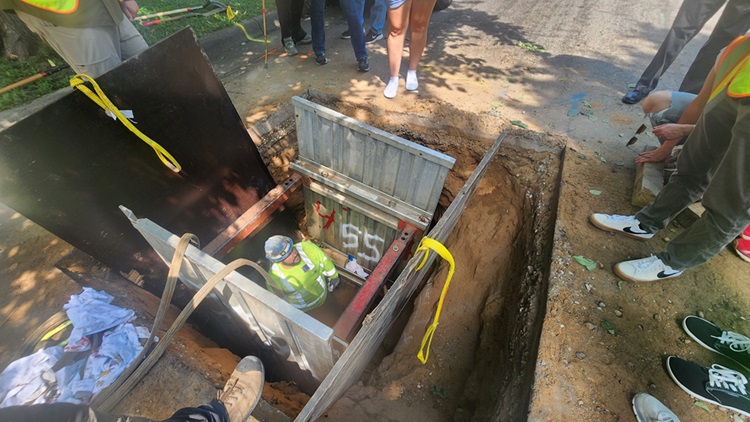
The Lead and Copper Rule (LCR) operates on the idea that the public has a right to know about its drinking water. Lead can be especially detrimental to infants and children, leading to a decrease in IQ and attention span, which can have lifelong impacts. While drinking water is only one potential source of lead, the LCR is focused on reducing lead exposure for all, regardless of socioeconomic background.
Lead and Copper Rule and the Safe Drinking Water Act (SDWA)
The original Lead and Copper Rule was established in 1991 under the Safe Drinking Water Act. It was revised under the Lead and Copper Rule Revision (LCRR) in 2021 in response to the Flint, Michigan, water crisis. And in 2024, the Lead and Copper Rule Improvement (LCRI) was finalized. Because lead service lines and internal pipes are most commonly found in older homes and apartment buildings, most times lived in or owned by people with fewer resources to make updates and upgrades to their homes, the LCRI strengthens enforcement in these main areas.
The LCRI goes into effect in 2027. It seeks to improve communication and transparency between water suppliers and all their consumers. The LCRI requires a water system to communicate information on lead levels in the community. Depending on the level of lead found within a community, these communication materials include information within the community’s annual Consumer Confidence Report, information on sources of lead, how people can reduce their exposure to lead, and how people can get water or blood lead levels tested.
To provide further reach for this information and to make sure that a community’s most vulnerable populations are aware of their service line materials, this information must specifically be distributed to locations such as schools, medical clinics, and family care clinics. Additionally, any customer who participates in tap sampling will receive information on their individual tap sample result along with steps to reduce their exposure to lead.
Lead and Copper Rule: Health Equity in Action
While these requirements set the foundation for health equity, the LCRI expands upon this idea in a few notable areas.
First, the required language on public education materials has been updated to improve readability and understanding.
Additionally, public education materials must be accessible in another language if a significant portion of the population served by the water system speaks a language other than English, providing everyone in the community with access to information on lead in drinking water and ways to limit exposure.
If a water system has multiple lead action level exceedances in a 5-year timeframe, it will be required to provide water filters to every consumer in the community. This ensures that the water system is providing continuous access to clean water for all consumers while the lead issue is being mitigated. Low-income individuals particularly benefit from this, as they may be unable to afford an alternative source of drinking water otherwise.
While the LCRI makes strives to improve health equity, the federal regulation has some gaps. MDH is attempting to fill these gaps by providing technical assistance and resources to small and rural communities in particular. Some examples are providing funding for water systems to obtain water filters for customers, funding for technical assistance and service line replacement projects, and providing small communities with materials to improve communication efforts. MDH is dedicated to implementing the federal requirements of the LCR and the LCRI while prioritizing health equity.
Minnesotans judge drinking water at the Great Minnesota Get-together
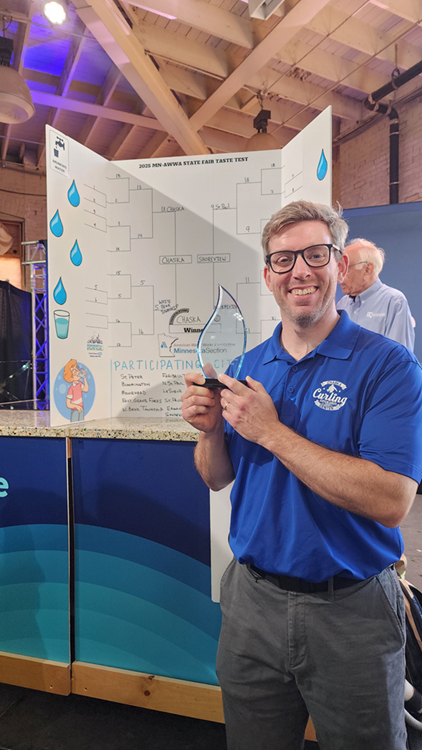
The 2025 “Great Minnesota Drinking Water Tap Taste Test” has a winner!
The City of Chaska, in the southwestern metro area, won the bracket championship, held in the Eco Experience at the Minnesota State Fair since 2012.
This year, contestants from 22 cities, from all over the state, brought in samples of their drinking water to share with the panel of judges, which happened to be everyone in the room.
With this award, Chaska became the first city to capture high honors twice in the competition. Shoreview came in second, and St. Paul and White Bear Township rounded out the final two finalist spots.
“This is a fun and important event here at the state fair,” says longtime host and DWP team member Stew Thornley. “It’s a great way to help people learn the importance of keeping our drinking water safe and plentiful in Minnesota.”
Adrian’s collaborative efforts against nitrate
by Kylie Jacobsen, Communications and Strategic Initiatives team
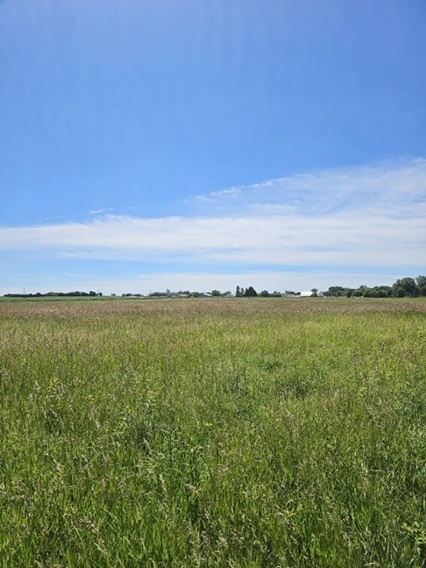
The city of Adrian is a small farming community located in Nobles County, in the southwest part of Minnesota. Adrian has experienced elevated levels of nitrate in its groundwater, prompting the city to treat its drinking water to reduce nitrate levels and comply with the Safe Drinking Water Standard. Adrian Public Utilities collaborated with Minnesota Rural Water Association (MRWA) and MDH to develop and implement a Wellhead Protection Plan aimed at addressing nitrate in their drinking water.
Adrian operates three drinking water wells situated near farmlands. Nitrogen is a nutrient included in most fertilizers to increase row crop productivity and yield. However, nitrogen not taken up by crops can leach into drinking water sources, depending on factors like precipitation and geology. One tool that has been effective in mitigating nitrate levels in groundwater is planting perennial native species.
Staff from MRWA, Board of Water and Soil Resources (BWSR), and Nobles County Soil and Water Conservation District (SWCD) collaborated to enroll three separate parcels of land next to the drinking water wells into perpetual easements. Enrolling these parcels into perpetual easements and planting native species will provide long-term protection from nitrate contamination. Additionally, Nobles County SWCD staff, with approval from landowners, planted cover crops on fields which will further reduce nitrate loading to the aquifer.
One example of an effective cover crop is Kernza (pictured above), a perennial grain that supports healthy soils and protects water resources.
Close cooperation with local farmers has had a profound effect in Adrian’s efforts to decrease nitrate levels in drinking water. Collaborating with farmers and landowners on utilizing cover crops and native plant species for nitrate reduction is essential to achieving the shared goal of safe drinking water.
Reminder to all water operators
When submitting water samples for analyses, remember to do the following:
- Take coliform samples on the distribution system, not at the wells or entry points.
- Write the date collected, time collected, and collector’s name on the lab form.
- Attach the label to each bottle (do not attach labels to the lab form).
- Include laboratory request forms with submitted samples.
- Do not use a rollerball or gel pen (the ink may run).
- Consult your monitoring plan(s) prior to collecting required compliance samples.
Notify your MDH district engineer of any changes to your systems.
Calendar
Operator training sponsored by MDH and Minnesota AWWA will be held in the coming months.
Register for schools and pay on-line: